To streamline your software development process with Agile methodologies in 2026, you need more than standups and sprints—you need a delivery system that reduces handoffs, tightens feedback loops, and makes priorities explicit. The pressure is real: AI-assisted coding accelerates output, customers expect continuous improvement, and security and compliance requirements keep rising. Agile, done well, is still one of the most reliable ways to ship value faster without turning your organization into a burnout machine.
But “doing Agile” often becomes theater: ceremonies without outcomes, backlogs that are dumping grounds, and teams that sprint but don’t finish. The goal of this guide is to help you streamline end-to-end—from idea to production—using Agile methodologies as an operating model, not a checklist. You’ll get practical patterns, examples, and a step-by-step checklist you can implement immediately.
Key Takeaways
- Streamlining with Agile starts by optimizing the whole value stream (discovery → delivery → operations), not just sprint mechanics.
- Choose a “fit-for-purpose” approach (Scrum, Kanban, or hybrid) based on work type, flow, and dependencies—not ideology.
- Make work smaller and outcomes clearer using user stories, acceptance criteria, and definition of done tied to production readiness.
- Reduce coordination overhead with stable cross-functional teams, explicit ownership, and an operating cadence that scales.
- Measure flow and quality (cycle time, WIP, defect escape, deployment health) to continuously improve and avoid Agile theater.
What does it mean to streamline a software development process with Agile?
Streamlining with Agile means reducing delays, rework, and handoffs so that valuable software reaches users reliably and frequently. In practice, that’s shorter feedback loops, clearer prioritization, smaller batch sizes, and built-in quality. The result is faster learning and fewer surprises—especially when requirements, markets, or regulations change.
Think of Agile as a system for managing uncertainty. It replaces long planning cycles with iterative discovery and delivery, so teams can adjust to reality rather than defend a plan that’s already outdated. McKinsey notes that organizations with high enterprise agility can combine stability with the ability to quickly redirect people and priorities toward new value-creating opportunities (McKinsey). That “stable core, flexible edge” is exactly what streamlining requires.
Where do most development processes get stuck (and how Agile fixes it)?
Most processes slow down in the gaps: unclear requirements, overloaded teams, excessive approvals, and late-stage testing that discovers problems when they’re expensive to fix. Agile streamlines by making work visible, limiting work in progress, and integrating testing and stakeholder feedback continuously. The aim is predictable flow, not heroic effort.
Common bottlenecks Agile addresses
- Handoffs between analysts, developers, QA, security, and ops that create queues and miscommunication
- Large “big bang” releases that hide integration risk until late
- Backlogs packed with vague items that can’t be built, tested, or validated
- Context switching from too many parallel initiatives and interruptions
- Quality gates at the end rather than quality built into daily work
How Agile changes the system (not just the meetings)
Agile streamlining works when you redesign the system around fast learning: small increments, frequent integration, and regular stakeholder validation. That typically requires cross-functional teams, explicit work policies, and engineering practices that keep software deployable. Gartner emphasizes that successful agile software development requires more than frameworks—it needs essential practices and continuous learning (Gartner).
Which Agile methodology should you use: Scrum, Kanban, or a hybrid?
Use Scrum when you benefit from timeboxed planning and a sprint goal, Kanban when you need continuous flow and flexible priorities, and a hybrid when you have both discovery work and operational interrupts. The best choice depends on variability, dependency load, and release constraints—not what’s popular.
Decision guide: match method to work type
- Scrum: product teams building new capabilities with a clear roadmap and the ability to protect focus for 1–2 weeks
- Kanban: platform/ops teams handling mixed demand (incidents, small enhancements, compliance requests) where priorities shift daily
- Hybrid (Scrumban): product teams that must handle planned work plus interrupts, using sprint goals plus WIP limits
Anti-pattern: copying a framework without changing constraints
If leadership keeps injecting urgent work mid-sprint, Scrum will feel broken—because focus is being removed. If teams have heavy external dependencies, Kanban may expose the bottleneck but won’t fix it without organizational changes. Start by mapping constraints (approvals, environments, ownership, staffing), then pick the lightest method that creates discipline and visibility.
How do you design an Agile operating model that actually streamlines delivery?
An Agile operating model streamlines delivery by clarifying who decides priorities, how teams are formed, how work moves from idea to production, and how outcomes are measured. It replaces ad-hoc coordination with a repeatable cadence and explicit interfaces between teams. Done right, it reduces friction while increasing accountability.
Start with the value stream, not the org chart
Map your value stream from customer request to running software: intake → discovery → build → test → release → monitor → learn. Identify queues and rework loops, then remove them systematically. If your organization builds digital products across web and mobile, align teams to customer journeys and platforms; for vendor benchmarking, see software development services and how different delivery models support Agile.
Define decision rights and interfaces
- Product: who owns the product backlog, who approves roadmap changes, and how customer feedback is incorporated
- Architecture: what decisions are team-local vs. governed (e.g., security patterns, data standards)
- Delivery: release ownership, environment ownership, and incident response responsibilities
- Funding: how capacity is allocated to products vs. projects, and how priorities are revisited
How do you build an Agile backlog that reduces rework and accelerates flow?
A streamlined Agile backlog is a decision tool, not a storage bin. It contains a small set of well-formed, outcome-oriented items that teams can build, test, and validate quickly. The key is disciplined refinement: clarify value, define acceptance criteria, split work into small slices, and remove items that no longer matter.
Write better stories: value, behavior, evidence
High-quality user stories describe value (why), behavior (what), and evidence (how we’ll know). Add acceptance criteria that are testable and tie them to analytics or observable outcomes when possible. Keep stories small enough to complete within a few days; if you can’t, split by workflow step, user segment, or capability toggle.
Backlog refinement checklist (practical and fast)
- Confirm the customer problem and the intended outcome (not just a feature request).
- Identify dependencies early: data, APIs, design, security review, legal/compliance, and environment access.
- Define acceptance criteria and edge cases; capture non-functional requirements (latency, audit logs, accessibility).
- Split into thin vertical slices deliverable to production behind a feature flag.
- Add a test approach (unit, integration, contract, security) and observability needs (logs/metrics/traces).
- Remove or park items that no longer align to current strategy.
How do you structure Agile teams to minimize handoffs and dependencies?
Streamlined Agile teams are stable, cross-functional, and aligned to a product or value stream with clear ownership. They contain the skills needed to deliver end-to-end—product, design, engineering, and quality—so work doesn’t bounce between departments. Dependencies won’t disappear, but team design can drastically reduce them.
Team patterns that streamline delivery
- Stream-aligned teams: own a customer journey or product area and deliver independently most of the time
- Platform teams: provide paved roads (CI/CD, identity, logging) so product teams don’t reinvent infrastructure
- Enabling teams: temporarily help with skills gaps (testing, security, performance) and then move on
- Complicated-subsystem teams: own specialized components (e.g., pricing engine) with well-defined APIs
Roles that matter (and what they should stop doing)
A strong Product Owner (or product manager) optimizes for outcomes and tradeoffs—not just ticket grooming. Engineering leadership must protect focus and build quality systems, not act as human routers for every decision. Scrum Masters (or flow coaches) should remove systemic blockers and improve cadence, not police ceremonies.
How do you streamline Agile ceremonies so they drive outcomes, not overhead?
To streamline Agile ceremonies, make each meeting answer a specific decision question, timebox it, and use artifacts that reduce follow-up. Ceremonies should move work forward: align on goals, surface risks early, and improve the system. If a ceremony doesn’t change decisions or behavior, redesign or remove it.
A lean ceremony set (Scrum example)
- Sprint planning: define a sprint goal, confirm top stories meet “ready” criteria, and negotiate scope based on capacity
- Daily standup: coordinate around blockers and flow; avoid status reporting to managers
- Review/demo: validate increments with stakeholders and capture feedback as backlog changes
- Retrospective: choose 1–2 improvement experiments; assign owners and check results next retro
Kanban cadence that improves flow
For Kanban, replace sprint-heavy mechanics with flow-focused touchpoints: replenishment (what’s next), daily flow review (where work is stuck), and service delivery review (how the system performs). Use explicit WIP limits and policies so the team pulls work only when it can finish it. This is where work in progress control creates real speed.
How do engineering practices (DevOps, CI/CD, testing) make Agile faster?
Agile only streamlines delivery when engineering practices keep the product continuously releasable. CI/CD, automated testing, trunk-based development, and observability reduce integration risk and shorten feedback cycles. Without them, teams “finish” stories that can’t be safely deployed, creating hidden queues and end-of-sprint crunch.
Build quality in: definition of done that includes production readiness
- Definition of done includes code review, automated tests passing, security checks run, and deployability verified
- Feature flags for incremental release and rollback safety
- Contract testing for APIs to reduce cross-team breakage
- Performance budgets and accessibility checks embedded in pipelines
- Operational readiness: dashboards, alerts, runbooks, and on-call ownership agreed
Automation and integration as streamlining multipliers
Streamlining often hinges on removing manual steps: environment provisioning, test execution, and release coordination. If you’re modernizing delivery pipelines or reducing manual handoffs between systems, pair Agile with automation patterns from Leveraging Automation in Software Development for Efficiency. For teams integrating multiple business systems, stronger integration discipline also reduces rework; see API Integration for Business Operations: A Practical Guide.
How do you scale Agile across multiple teams without creating bureaucracy?
Scaling Agile without bureaucracy requires aligning teams around products, standardizing only what improves interoperability, and managing dependencies through architecture and planning horizons—not more meetings. Use a lightweight portfolio layer to set priorities and funding, while keeping teams autonomous in execution. The goal is coordinated outcomes, not synchronized ceremonies.
Use product-based planning horizons (Now / Next / Later)
Replace annual “big plan” commitments with rolling horizons. “Now” is high-confidence work tied to current capacity; “Next” is shaped and sized; “Later” is directional and hypothesis-driven. This reduces thrash while still giving leadership visibility. It also supports rapid reprioritization—an attribute McKinsey associates with high enterprise agility (McKinsey).
Dependency management that doesn’t kill speed
- Prefer APIs and contracts over shared databases; treat internal consumers like external customers
- Create “paved road” platform capabilities (identity, logging, CI templates) to reduce bespoke work
- Use integration demos and contract tests to detect breaks early
- Limit cross-team commitments; when unavoidable, timebox them and assign single-threaded owners
- Document lightweight architecture decisions (ADRs) so teams don’t re-litigate basics
How do you measure Agile success without incentivizing the wrong behavior?
Measure Agile success by flow, quality, and outcomes—not by story points or utilization. The best metrics reveal bottlenecks and learning speed: cycle time, throughput trends, WIP, defect escape rate, and customer impact measures. Use metrics to drive improvement experiments, not to rank teams.
A practical Agile metrics set (balanced)
- Cycle time: how long work takes from “in progress” to “done” (focus on trend and variability)
- WIP and blocked time: how much work is open and how long it sits waiting
- Deployment health: frequency, rollback rate, incident volume tied to releases
- Quality: escaped defects, flaky tests, and rework percentage (qualitative if you can’t measure yet)
- Outcome signals: activation, retention, support ticket themes, time-to-resolution, or SLA compliance
Use research-backed performance claims carefully
When building a business case, avoid inventing ROI numbers. One grounded reference: McKinsey reports that agile transformations across industries have achieved up to 30% increases in productivity and implementation speed while reducing residual defects by over 70% (McKinsey). Treat these as directional potential, not guaranteed outcomes—your results depend on engineering practices, leadership behaviors, and constraints.
How can Agile help reduce IT as a bottleneck in enterprise environments?
In enterprises, Agile reduces IT bottlenecks by shifting work from ticket queues to product teams, standardizing repeatable delivery paths, and automating routine operations. The biggest gains come from reducing unplanned work and simplifying support. This requires leadership commitment to change funding, ownership, and service models—not just team rituals.
Modernize the support model: from projects to products
If every request becomes a bespoke project, throughput collapses. Product-based ownership creates long-lived accountability: teams own outcomes, reliability, and technical health over time. McKinsey describes how introducing true agile methods to enterprise IT work can radically reduce resources needed to support systems while improving service quality (McKinsey).
Governance that enables speed (instead of stopping it)
Streamlined governance sets guardrails—security patterns, data handling rules, release controls—then lets teams move quickly inside them. Replace one-off approvals with automated checks and pre-approved templates. If your work includes AI-based features, make governance explicit early; for ecosystem context, explore AI development providers and the operational expectations that come with AI-enabled products.
Practical examples: what streamlining with Agile looks like in real teams
Streamlining becomes real when you can point to fewer queues, smaller releases, and faster learning cycles. The examples below are illustrative scenarios based on common patterns teams face. Use them as templates for diagnosing your own bottlenecks and selecting the smallest change that improves flow.
Example 1 (illustrative): SaaS product team stuck in “QA at the end”
A B2B SaaS team ships every four weeks because QA regression is manual and starts late. They streamline by adding test automation for high-risk paths, tightening definition of done to include automated checks, and using feature flags to decouple deploy from release. Within a few iterations, QA becomes a continuous activity, not a phase, and releases become smaller and less risky.
Example 2 (illustrative): Enterprise team overloaded by “urgent” stakeholder requests
A team’s sprint plan collapses weekly due to executive interrupts. They introduce an intake policy with two lanes: planned sprint work and an expedite lane with strict WIP=1. Stakeholders must trade off: adding an expedite item requires removing or pausing something else. The team’s cadence stabilizes and predictability improves without ignoring real emergencies.
Example 3 (illustrative): Multi-team platform dependency slows every feature
Product teams depend on a central platform group for environment changes and identity updates, creating a queue. Streamlining starts by turning the platform into a “paved road” provider: self-service templates, documented golden paths, and automated provisioning. Product teams regain autonomy while the platform team focuses on reliability and reusable capabilities.
Example 4 (illustrative): Regulated product needs speed without breaking compliance
A regulated product team fears frequent releases due to audit and security reviews. They streamline by shifting compliance left: threat modeling during refinement, automated security scanning in CI, and audit-friendly change logs generated from pull requests. For deeper context on balancing protection and delivery speed, see SaaS Security in Healthcare: How to Protect Patient Data Without Slowing Innovation.
How do you integrate systems engineering and architecture with Agile (without slowing down)?
Integrating systems engineering with Agile means planning for end-to-end behavior—requirements, interfaces, verification, and lifecycle concerns—while still delivering in increments. You do this by making architecture an ongoing activity, using thin slices, and validating system-level qualities continuously. The goal is to avoid “architecture vs. Agile” as a false choice.
Use “architectural runway” and continuous validation
Treat architecture as a set of evolving constraints and enablers: API standards, data models, deployment patterns, and security baselines. Build just enough runway to support near-term features, then iterate based on learnings. McKinsey notes that organizations seeking to enhance software delivery should adopt an operating model combining agile principles with a true systems engineering approach across all phases (McKinsey).
When architecture decisions should be centralized vs. team-local
Centralize decisions that protect the enterprise (security controls, data governance, compliance patterns). Decentralize decisions that enable speed (internal module design, UI composition, refactoring tactics) as long as teams stay within guardrails. If you’re selecting frameworks and infrastructure that affect long-term flow, align choices with delivery constraints; stack decisions can streamline or sabotage Agile.
How do you adopt Agile successfully (and avoid Agile theater)?
Successful Agile adoption focuses on capabilities: product thinking, engineering excellence, and continuous improvement—not just training on a framework. Start with one or two value streams, measure flow and quality, and scale only after you can reliably deliver. Gartner highlights that agile success requires core skills and continuous learning, beyond process frameworks (Gartner).
Common signs of Agile theater (and what to do instead)
- Teams “complete” stories but can’t deploy: fix CI/CD, testing, and release ownership; redefine done.
- Backlog grows endlessly: introduce ruthless prioritization, WIP limits for discovery, and regular backlog cleanup.
- Story points become performance targets: shift to flow and outcome metrics; stop comparing teams.
- Retrospectives repeat the same issues: limit to 1–2 experiments, assign owners, and review results.
- Leadership overrides priorities weekly: implement explicit intake policies and tradeoff rules.
People and skills: the hidden constraint
Agile streamlining often fails because teams lack key skills: test automation, product discovery, modern architecture, or incident management. Treat capability building as part of the plan—pairing, internal enablement, and targeted hiring. If you’re benchmarking compensation or planning growth, use IT salary data by city and role to inform realistic staffing strategies for product teams.
Implementation checklist: streamline your development process in 30–90 days
Use this checklist to move from “Agile ceremonies” to a streamlined delivery system. Start small, pick one value stream, and run improvement experiments with clear success measures. The goal is compounding gains: fewer queues, smaller releases, and better quality. Treat each step as an iteration—inspect, adapt, and keep what works.
Days 1–15: diagnose and set guardrails
- Map the value stream (idea → production) and identify the top 3 queues (handoffs, approvals, environments, testing).
- Define a clear product goal and success measures (one outcome metric + one quality metric).
- Choose the lightest-fit method (Scrum, Kanban, or hybrid) and define your minimum ceremony set.
- Create explicit work policies: intake rules, expedite lane, and WIP limits.
- Draft a definition of done that includes deployability and basic observability.
Days 16–45: improve flow and build quality in
- Reduce batch size: split top backlog items into thin vertical slices deliverable behind feature flags.
- Automate the highest-value tests first (smoke, critical user paths, API contract tests).
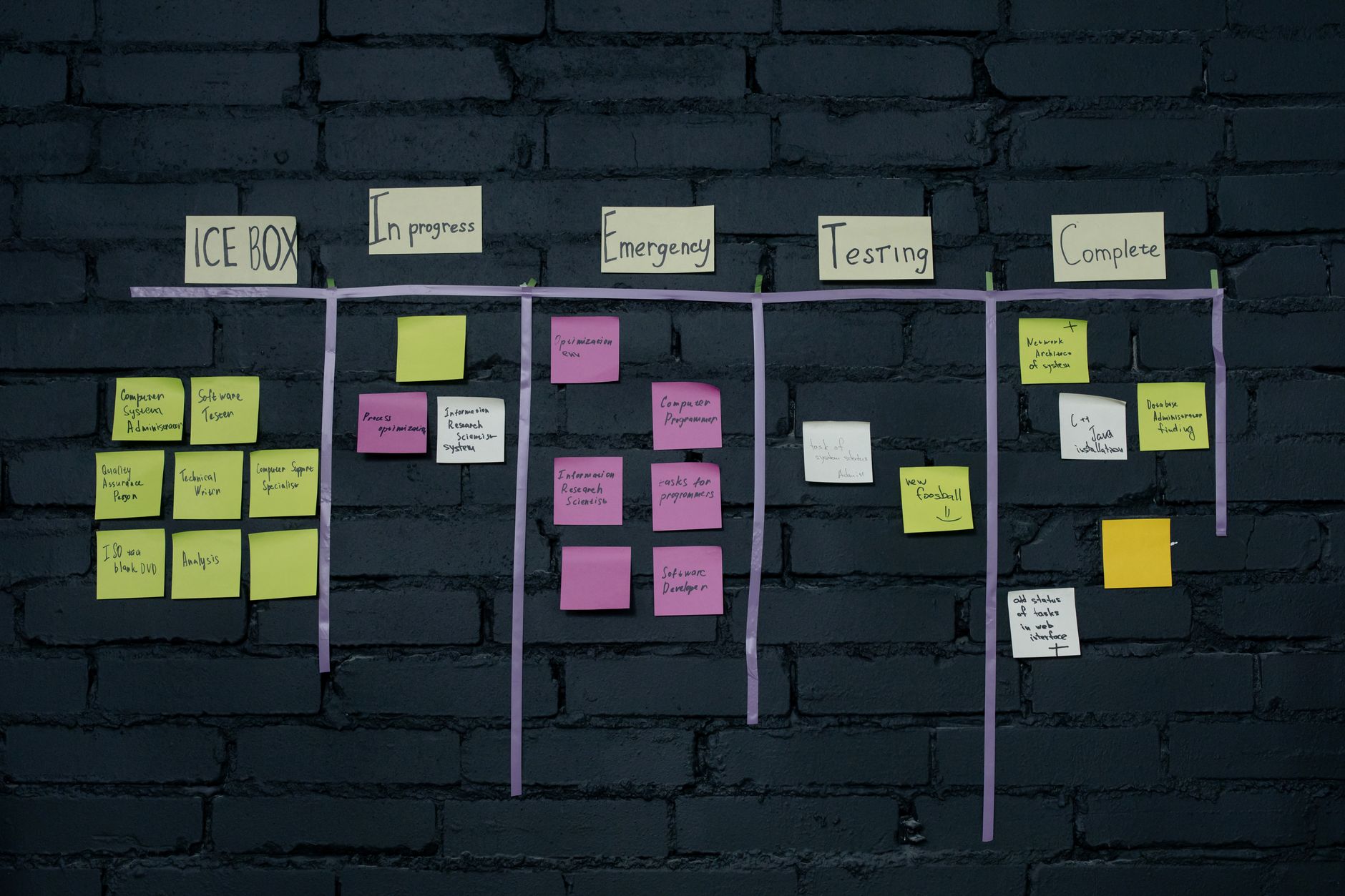
- Make work visible: a board that reflects real states (including review, test, security, deploy).
- Start measuring flow: cycle time trend, blocked time, and WIP aging.
- Run two retrospectives focused on system changes (not personal performance).
Days 46–90: scale the practices that work
- Stabilize team ownership: reduce shared responsibilities and clarify on-call and release ownership.
- Standardize “paved road” delivery paths (CI templates, security scans, deployment patterns).
- Introduce lightweight portfolio alignment (Now/Next/Later) and quarterly outcome reviews.
- Document key architecture decisions with ADRs and enforce API contracts for cross-team work.
- Expand to the next value stream only after you can ship reliably with low rework.